
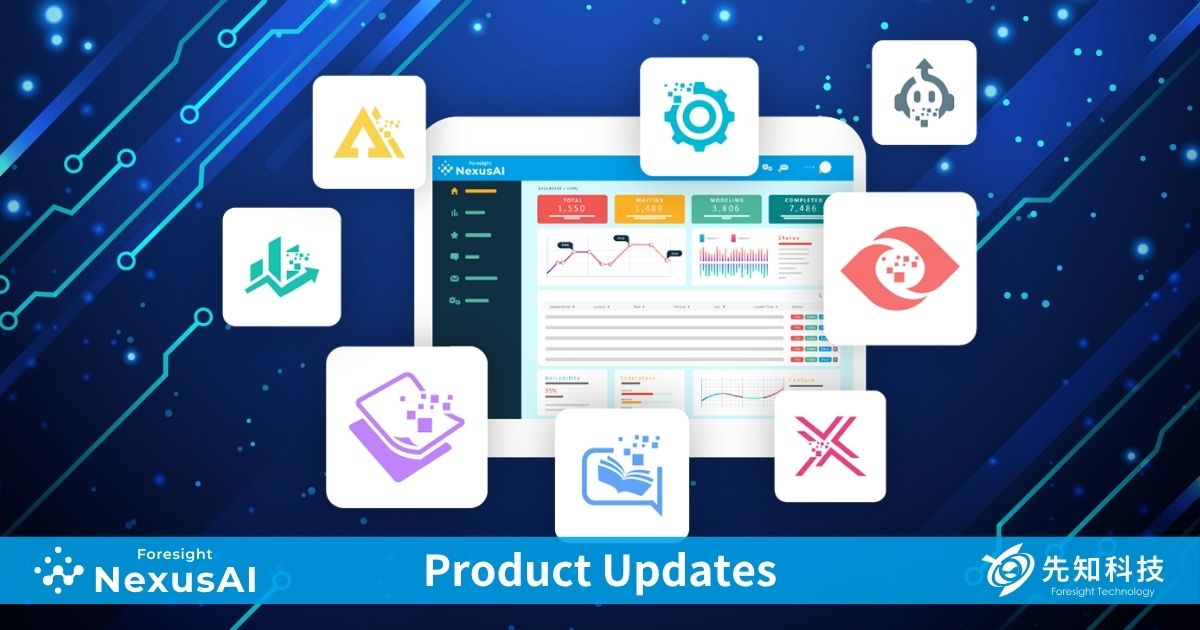
Foresight Technology Launches NexusAI R2026b

Major updates are now available across five AI modules in the NexusAI strategic smart manufacturing platform.
NexusAI R2026b introduces new capabilities for AI vision inspection, data analytics and prediction, generative knowledge management, multimodal engineering drawing intelligence, and market decision support.

AI Vision Inspection & Recognition Module

AI Data Analytics & Prediction Module

Generative AI Knowledge Management Module

Multimodal AI Drawing & Document Intelligence Module

AI Market Intelligence & Decision Support Module
1. SkyEyes | 2026b Updates
1-1. Intelligent Rotatable Annotation and Fully Automated AI-Assisted Labeling
Introduces Labeling Rotate and rotation for segmentation polygon lines. The update supports automatic annotation and class labeling for KeyPoint and Segmentation tasks, with cross-image copy-and-paste and shortcut safeguards to reduce labeling errors.
Application Scenarios and Pain Points
Conventional image inspection struggles with irregular, angled, and minute defects, such as textile edges, circular components, or metal-machined parts. Manual bounding-box labeling is highly time-consuming, while overlapping polygons can lead to model misclassification. Many factories also lack advanced AI data-labeling specialists.
Business Benefits
Labeling time can be reduced by more than 70%. With automated labeling and on-demand rotation tools, frontline quality inspectors and technicians can build AI models without coding expertise, making no-code deployment a practical reality.
Applicable Scenarios / Deployment Considerations
Suitable for precision semiconductor packaging and testing, PCB carriers, textile production, and steel-sheet cutting lines.
International relevance: Highly suited to rapid adoption at Southeast Asian factories where AI specialists are scarce.
1-2. Performance Visualization and Automated Retraining Safeguards
Enhances error filtering in YOLO and Fast R-CNN confusion matrices. The system can automatically identify misclassified images for relabeling and retraining, while adding detailed model-result views, including best-score mAP50 indicators and charts, plus downloadable test results.
Application Scenarios and Pain Points
AI models can feel like a black box. When defect A is misclassified as defect B, on-site engineers may not know how to adjust the model. During demanding audits by global customers, including Japanese customers, teams also need intuitive reports and acceptance evidence.
Business Benefits
Defect-detection accuracy can exceed 95%, while quality-communication costs can be reduced by 30%. Model scores and confusion matrices become transparent through visual reports, and the system automatically surfaces suspect images for retraining so models continue to improve over time.
Applicable Scenarios / Deployment Considerations
Suitable for premium Grade A product screening and export-oriented food-processing audits, such as insect-damage and discoloration classification in edamame.
International relevance: Supports the strict quality-consistency and compliance-documentation expectations of Japanese and U.S. markets.
1-3. Flexible Data Matrix Compatibility and Full Inspection for Specialized Workpieces
Improves recognition compatibility for Data Matrix codes and supports specialized high-mix, low-volume inspection scenarios, including dead-insect defect detection.
Application Scenarios and Pain Points
Traditional AOI equipment is typically locked into fixed specifications, making it difficult to support high-mix, low-volume orders. When barcodes are reflective, skewed, worn, or placed on uneven surfaces, such as agricultural products or printed metal parts, missed detections can lead to customer complaints and entire-batch scrap.
Business Benefits
Order-to-production speed can increase by up to three times while missed-detection rates decline. SkyEyes uses high-compatibility algorithms to perform optical-code and fine-defect inspection with 100% inspection feedback in parallel with high-speed weight and dimension sorting.
Applicable Scenarios / Deployment Considerations
Suitable for hardware parts and automotive mechanical components, 3C electronic cable assembly, food processing, and traditional manufacturing.
International relevance: Can be replicated across reshored automotive and aerospace supply chains in Europe and North America.
2. AIUPS | 2026b Updates
2-1. AI Visual Analytics Upgrade (EDA 2.0 and Intelligent Charting)
The new EDA 2.0 interface adds a broader range of interactive visualizations, including candlestick charts, stream graphs, bubble charts, treemaps, sunbursts, circle packing, radar charts, mathematical curves, error bars, 3D bar charts, Q-Q plots, and word clouds. These chart types help users quickly understand distributions, trends, anomalies, and group characteristics.
Application Scenarios and Pain Points
Traditional statistical charts are often insufficient. Engineers spend significant time switching between tools and preparing data, making it difficult to identify key insights quickly.
Business Benefits
- Complete data exploration and visual analysis in one platform.
- Identify anomalies and trends faster.
- Enable managers to generate reports and decision-ready evidence directly.
- Lower the barrier to data analysis and improve cross-functional communication efficiency.
Applicable Scenarios / Deployment Considerations
Applicable to manufacturing, quality management, R&D, production, ESG, energy management, and other data-analysis scenarios. The new capabilities are available after the update; no model retraining is required.
2-2. Enhanced AI Analytics and Clustering (Auto Analytics)
Adds intelligent analysis modules including t-SNE, dimensionality reduction, Kohonen Self-Organizing Maps, K-Means, TwoStep Cluster, Parallel Analysis, Dendrograms, Sequence Analysis, and association rules (CARMA). These capabilities support automated clustering, feature exploration, process analysis, and association discovery.
Application Scenarios and Pain Points
Large data sets can be difficult to classify effectively, hidden relationships are easy to miss, and analyses often rely heavily on expert experience. Improvement opportunities can therefore be difficult to quantify.
Business Benefits
- Automatically uncover hidden groups and abnormal patterns.
- Identify key factors and optimal process conditions faster.
- Reduce manual analysis time.
- Improve the efficiency of AI modeling and decision-making.
Applicable Scenarios / Deployment Considerations
Suitable for quality improvement, process optimization, customer segmentation, anomaly analysis, equipment monitoring, and predictive-model development. Supports analysis of large data sets.
2-3. Platform Integration and Enterprise Management Upgrade (Enterprise-Ready)
Adds LDAP account integration and enterprise permission management. AIUPS can connect with Active Directory and LDAP to centralize authentication and account administration, strengthening enterprise deployment capabilities.
Application Scenarios and Pain Points
Large organizations need centralized account and permission management to avoid duplicate user creation and reduce the complexity of information-security administration.
Business Benefits
- Support an enterprise single sign-on (SSO) management model.
- Reduce IT maintenance costs.
- Improve information-security and permission-control efficiency.
- Accelerate cross-department adoption of the AI platform.
Applicable Scenarios / Deployment Considerations
Suitable for enterprise editions, on-premises deployments, and private-cloud environments. LDAP or Active Directory services are required, and Foresight Technology can assist with integration and deployment.
3. KnowledgeConnect | 2026b Updates
3-1. Enterprise AI Knowledge Base and Multimodal Document Understanding
Supports summarization, translation, Q&A, and key-point extraction across PDFs, Word documents, PowerPoint presentations, Excel files, images, text files, and audio files. OCR, table extraction, and document-image analysis can be used to build an enterprise retrieval-augmented generation (RAG) knowledge base.
Application Scenarios and Pain Points
Enterprise knowledge is often scattered across SOPs, DCCs, ECNs, policies, FAQs, training materials, and maintenance records. Information is difficult to find, knowledge is hard to transfer, and onboarding costs are high.
Business Benefits
Employees can obtain company knowledge through natural-language questions, reducing document-search time and preserving senior employees’ experience. Knowledge becomes a conversational enterprise advisor rather than a static archive.
Applicable Scenarios / Deployment Considerations
Suitable for manufacturing SOPs, equipment maintenance, quality-assurance documents, training materials, customer-service FAQs, internal policies, and technical document management.
3-2. Enterprise-Grade Access Control and Secure Deployment
Provides department and group permissions, personal knowledge bases, and enterprise knowledge bases. Supports cloud or on-premises LLM deployment to protect confidential enterprise information.
Application Scenarios and Pain Points
Many organizations are reluctant to upload confidential documents to external AI services. Different departments require different levels of access, and insufficient controls can create data-leakage and governance risks.
Business Benefits
Query scopes can be controlled by department, role, and individual user. Questions, cited sources, tools used, and timestamps can also be recorded, balancing AI productivity, information security, and traceability.
Applicable Scenarios / Deployment Considerations
Suitable for semiconductor, electronics, manufacturing, finance and legal functions, corporate groups, cross-functional knowledge management, internal audit, and compliance requirements.
3-3. AI Agent and Text-to-SQL Decision Assistant
Allows users to query ERP, MES, SPC, FDC, EAP, WMS, and other databases through natural language. AI Agents turn document search, database queries, chart generation, and report creation into traceable tasks.
Application Scenarios and Pain Points
Operational and management data is often dispersed across multiple systems. Reports depend on IT teams or manual Excel work, making it difficult for managers to track KPIs and identify causes of anomalies in time.
Business Benefits
Users can retrieve data, create tables and charts, and prepare reports without SQL knowledge, accelerating management decisions. AI Agent workflows are traceable, making analytical results more transparent and trustworthy.
Applicable Scenarios / Deployment Considerations
Suitable for production management, quality analysis, equipment anomalies, OEE/KPI monitoring, operational reports, cross-system data queries, and executive war rooms.
3-4. 8D / F8D Quality Improvement and Knowledge Closed Loop
Planned support includes the D0-D8 workflow, 5W2H, Why-Why analysis, fishbone diagrams / 5M1E, improvement-effectiveness validation, ECN/DCC integration, and human-in-the-loop review.
Application Scenarios and Pain Points
Writing 8D reports is time-intensive, root-cause analysis relies heavily on experienced personnel, and corrective actions are difficult to connect with document version control, engineering changes, and historical anomaly cases.
Business Benefits
AI can assist with root-cause questioning, fishbone diagrams, improvement recommendations, and first-draft reports, while managers retain approval authority. The platform connects anomaly handling, knowledge capture, and ECN/DCC document updates into a closed improvement loop in an enterprise-controlled and supervised environment that reduces the risk of confidential data leakage.
Applicable Scenarios / Deployment Considerations
Suitable for quality-assurance 8D workflows, customer complaints, process and equipment anomalies, quality improvement in semiconductor, electronics, and manufacturing environments, internal audits, and continuous-improvement management.
4. BlueprintLegacyAI | 2026b Updates
4-1. Blueprint OCR and Analysis
Adds PDF OCR for engineering drawings and improves high-accuracy recognition of title blocks, labels, and drawing tables (Zumen) located in the lower-right corner of CAD drawings. It can automatically identify counts of key components on engineering drawings.
Application Scenarios and Pain Points
When OEM and ODM manufacturers receive customer design drawings, often in PDF or image formats, senior engineers may spend hours reviewing drawings, counting components manually, and transcribing field specifications. This process is slow, error-prone, and can seriously delay quotation and production planning.
Business Benefits
Engineering drawing review and part breakdown can be accelerated by 300%. AI automatically extracts drawing highlights and component counts, reducing half-day manual drawing decomposition to minutes while significantly reducing human error and the time spent on manual forms and reports.
Applicable Scenarios / Deployment Considerations
Suitable for hardware components, fasteners, carrier substrates, electronics assembly (SMT), and precision-machining industries.
International relevance: Highly suited to rapid adoption at Southeast Asian factories where AI specialists are scarce.
4-2. Visual Difference and Revision Audit
Enables automated comparison of subtle visual differences between two images, PDFs, or different revisions of CAD designs. The system performs intelligent drawing reviews and highlights all revision differences.
Application Scenarios and Pain Points
Customers frequently issue sudden design revisions. Without automated comparison tools, engineers must visually inspect differences between old and new drawings. Missing a small tolerance change can trigger production errors, rework, and scrap across an entire batch.
Business Benefits
Find all modification points in as little as three minutes and drive rework toward zero. By overlaying old and new drawings, AI automatically highlights changed hole diameters, dimensions, and lines, allowing sales teams and project managers to inform production immediately and avoid hidden obsolete-inventory risk.
Applicable Scenarios / Deployment Considerations
Suitable for fasteners, molds, bicycle frame design, connectors, and fluid-power component industries.
International relevance: Supports automotive and precision-parts audits in Japanese and U.S. markets, where product specifications are highly demanding and design changes are frequent.
4-3. Natural-Language CAD Search and Interactive Analytics
Deeply integrates LLM-based generative AI with enterprise databases such as ERP and MES. Users can search historical drawings and specifications through natural language, including text-to-image and text-to-text search, or use conversation to request decision charts and recommendations.
Application Scenarios and Pain Points
Manufacturers may have tens of thousands of historical drawings and ERP specification fields accumulated over decades, distributed across different locations with inconsistent naming. When sales teams or new engineers need similar historical designs and quotation structures for reference, finding them can feel like searching for a needle in a haystack and often results in redrawing from scratch.
Business Benefits
Retrieve valuable historical know-how through conversation in as little as 20 seconds. Users can ask questions in natural language, retrieve data quickly, generate charts automatically, reduce estimating and quotation time by 25% to 50%, and potentially increase gross margin on won orders by 3% to 8%.
Applicable Scenarios / Deployment Considerations
Suitable for advanced engineering and management decisions, potential-customer and new-market sentiment analysis, and large-scale cross-system ERP/MES data search.
International relevance: Addresses technical-skill gaps and core-knowledge retention needs in Japan, while supporting the high-speed, agile quotation requirements of European and U.S. markets.
4-4. Multimodal CAD Generation and Maintenance AI
Develops capabilities to convert hand sketches and photographs into CAD formats, compare drawings, automatically decompose manufacturing drawings from design drawings, and generate CAM machine programs. Machine-maintenance videos and photos can also be connected to CAD workflows and paired with smart glasses for factory maintenance training.
Application Scenarios and Pain Points
Many traditional industries remain at an early stage of digitalization, with incoming materials available only as photos or hand-drawn sketches. After an order is received, engineers may still manually decompose drawings, plan process steps, and write CAM programs, extending the cycle time from order receipt to production launch.
Business Benefits
Reduce the time from idea to production launch by more than 50%. Hand sketches and photos can be transformed into digital information immediately. When design drawings are uploaded, the system can generate process-flow recommendations and machine programs, lowering the barrier to AI adoption and establishing a resilient, intelligent operations hub across the plant.
Applicable Scenarios / Deployment Considerations
Suitable for mold making, composite machining processes, smart-glasses-enabled remote maintenance and digital training, and traditional-manufacturing transformation.
International relevance: Aligned with strong demand for adaptive Industry 4.0 operations, smart disaster prevention, and predictive maintenance in Taiwan, the United States, Japan, and Thailand.
5. Market Insight | 2026b Updates
5-1. Global Sentiment Momentum and New-Market Expansion Forecasting Engine
Integrates external, multi-source unstructured data, including global economic and trade news, social-platform activity, and Google Trends, with internal ERP/CRM inventory and procurement data. Combined with big-data time-series forecasting models, the update strengthens quantitative forecasting for sentiment momentum points (market-moving events), momentum duration, and new-market regions. It turns fragmented market sentiment into scientific leading indicators that help estimate and guide potential-customer demand.
Application Scenarios and Pain Points
- Information overload and blind overseas expansion: When businesses plan to enter new markets in the United States, Japan, or Southeast Asia, they may lack the geopolitical and sentiment data needed to act with confidence. Decisions often rely on veteran intuition rather than accurately sourced and quantified evidence.
- Market-moving events are difficult to quantify: Tariff policy shifts, interest-rate moves, macro supply-demand changes, and events such as sharp increases in steel prices can interact in complex ways. Manual reporting is time-consuming, while emotion can influence decision-making.
- Momentum duration is difficult to predict: Organizations may not know how long a trade issue or product trend will continue gaining momentum, leading to poor supply-chain stocking decisions and excessive financial-leverage risk.
Business Benefits
- Plan 2 to 4 months ahead to improve the success rate of winning cross-border business. AI identifies which new-market regions are gaining sentiment momentum through index importance, enabling more precise allocation of marketing and business-development budgets.
- Estimate short- and long-term futures contracts more accurately and reduce financial drawdown risk. By modeling environmental sentiment and time-lag effects, the platform narrows forecast error for futures and procurement prices, such as in U.S. steel-price scenarios, helping teams plan purchase volumes and safety stock earlier.
- Replace speculative decisions with evidence-based reasoning. Precision, Recall, and Win Rate provide multi-dimensional strategy indicators. Clear visualizations and adjustable sliders support dynamic scenario planning using expected sentiment indicators, giving decision-makers greater confidence.
Applicable Scenarios / Deployment Considerations
Suitable for cross-border manufacturing supply-chain management, including semiconductor equipment and materials, IC packaging and testing, PCB/flexible board manufacturing, metal products and steel, fasteners and molds, bicycle OEM manufacturing, paper, consumer chemicals, large-scale procurement, and sales-and-operations coordination decisions.
International relevance: International sales strategy: Taiwan-first / U.S. growth track – focuses on relationship forecasting across tariff policy, inflation and interest rates, trade events, and commodity prices to help Taiwan-U.S. businesses respond to rapid product iteration and market volatility. Japan market – emphasizes on-premises deployment and sensitive-data protection; localized vectorization and data processing support Japanese enterprise requirements for cybersecurity, regulations, and compliance.
Explore the R2026b Update in Your Own Industry Context
To learn how these updates can address different industries and use cases, we look forward to sharing practical insights and implementation experience with you.